
What Families & Future Residents Should Know
In Westwood, schools are more than just buildings where children spend their day. They are often the center of neighborhoods, shaping where families choose to live, how friendships form, and how communities grow together. Ask almost any homeowner why they chose Westwood, and the schools will almost certainly be part of the answer.
Because of that, even small changes to school policies tend to spark curiosity. Recently, Westwood Public Schools introduced the idea of elementary school “buffer zones,” a concept that has led many families to wonder what exactly it means. Is the school map changing? Will students be reassigned? Could it affect where new families decide to buy homes?
The good news is that for most residents, very little will change. But the introduction of buffer zones does offer an interesting look at how the district is planning ahead to keep Westwood’s classrooms balanced and manageable as enrollment continues to shift from year to year.
Westwood’s elementary schools are intentionally small and neighborhood-oriented, something families value deeply. That structure creates close connections between students, teachers, and the communities around each school. At the same time, the size of these schools means that enrollment changes can have a noticeable impact. Some years a school might see a surge in incoming kindergarten students while another nearby school has extra classroom capacity.
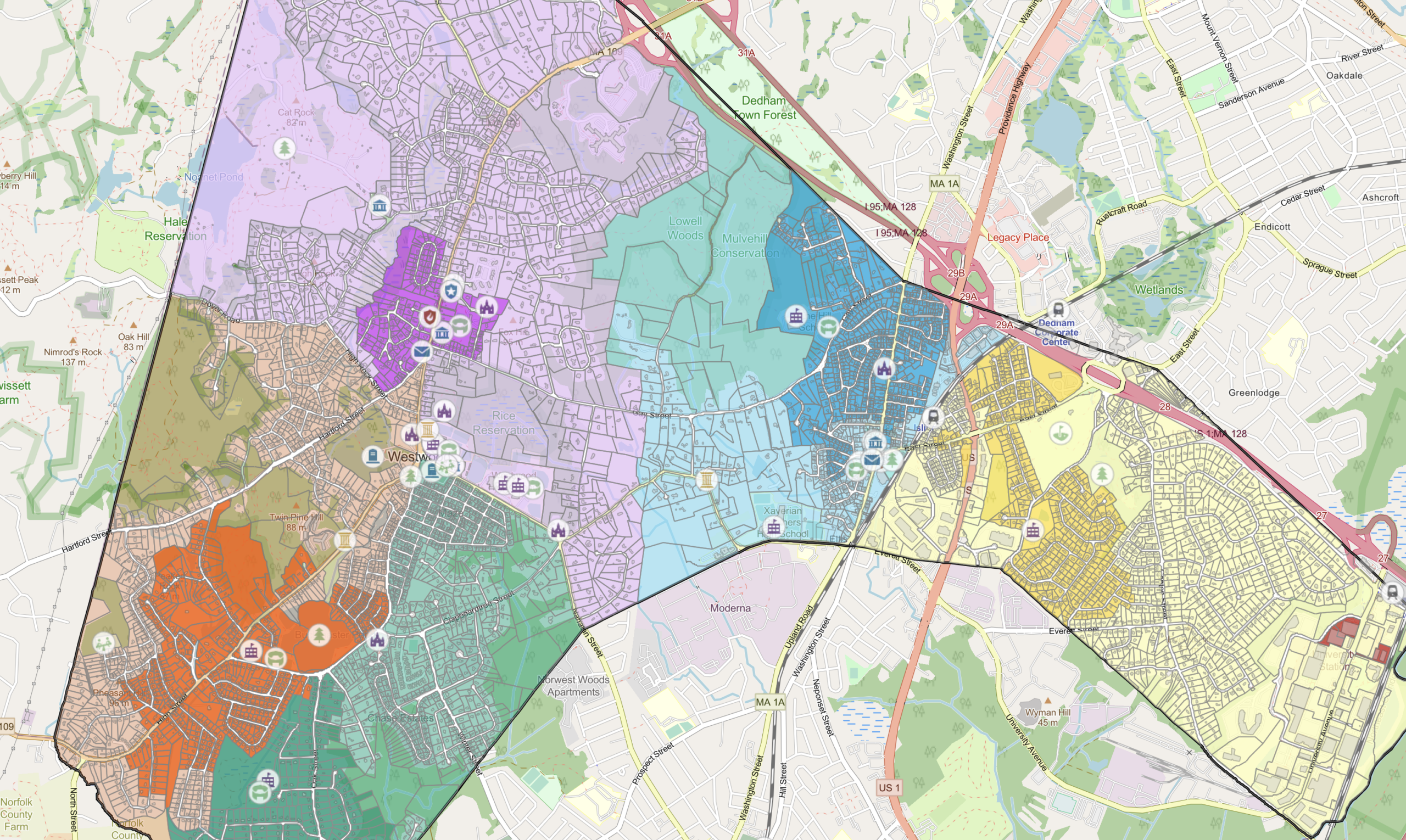
To help manage these fluctuations, the Westwood district has introduced buffer zones. These zones are small geographic areas located along the boundaries between two elementary school districts. Homes located within these areas may have newly registering students assigned to either of two nearby schools depending on enrollment levels at the time of registration.
It is important to note that the existing elementary school district map is not changing. Every address will continue to have a primary elementary school assignment. The buffer zone simply provides the district with flexibility if a particular school is approaching its recommended class size limits.
The School Committee has established guidelines for classroom sizes, recommending a maximum of 18 students per classroom for grades kindergarten through three and 20 students per classroom for grades four and five. Buffer zones would only be used if enrollment begins to approach those limits. Until that point, assignments would remain unchanged.
In practice, the number of families affected by this policy is expected to be relatively small. Buffer zones apply only to incoming kindergarten students, families moving into Westwood, or students entering the public school system from private schools. Current students will remain at their existing schools, and the district has made it clear that siblings will always be assigned to the same elementary school so families are not split between buildings.
Families whose homes fall within buffer zones will also have the opportunity to indicate their school preference during the registration process. While preference cannot be guaranteed if enrollment limits have been reached, the district will take it into consideration along with other factors such as proximity to the school, walkability, and transportation logistics. The goal is to maintain neighborhood connections whenever possible while balancing classroom sizes across the district.
Notification timelines depend on when families complete registration. Families who register by May 1 will receive their school assignment by May 15. Those who register between May 1 and June 1 will be notified by June 15. Registrations after June 1 will typically receive placement within three weeks or by August 20, whichever comes first. After August 20, assignments will be made on a rolling basis. The final decision ultimately rests with the Superintendent.
For current Westwood families, the policy should feel largely invisible. Students already attending elementary school will remain where they are, and younger siblings will continue to attend the same school. The purpose of buffer zones is not to move students who are already established in their school communities but rather to help the district manage future enrollment changes as new families arrive in town.
For those considering a move to Westwood, buffer zones add a small layer of flexibility near school district boundaries. Most homes will still have a clearly associated elementary school, but some addresses located near district lines may have the possibility of attending one of two nearby schools depending on enrollment levels in a given year. Given that many of Westwood’s elementary schools are only minutes apart, the practical difference for most families may be smaller than expected.
Policies like this can sound technical, but the intention behind them is straightforward: protecting the quality of Westwood’s classrooms. Balanced enrollment helps maintain manageable class sizes, supports teachers, and ensures that resources are used effectively across the district. In a community where education plays such a central role in daily life, thoughtful planning like this helps preserve what families value most about living here.
As someone who both lives and works in Westwood, I see firsthand how closely schools and housing decisions are connected. Families often begin their home search by asking about neighborhoods and school assignments long before they ever step inside a house. Understanding how policies like buffer zones work can help families make more informed decisions when evaluating neighborhoods or considering a move.
At Artemis Realty + Design, those conversations happen often. Sometimes the right decision is finding a new home in a neighborhood that better fits a family’s needs. Other times it’s discovering that the home you already live in simply needs to evolve with you. Either way, understanding the community around you is always the best place to begin. Contact us to learn more.